Event-based vision
Representations, recognition, detection, segmentation, tracking, and temporal learning from asynchronous visual data.
A research hub for event-based perception, human action understanding, sim-to-real transfer, robotic manipulation, and safe interaction with humans in dynamic environments.
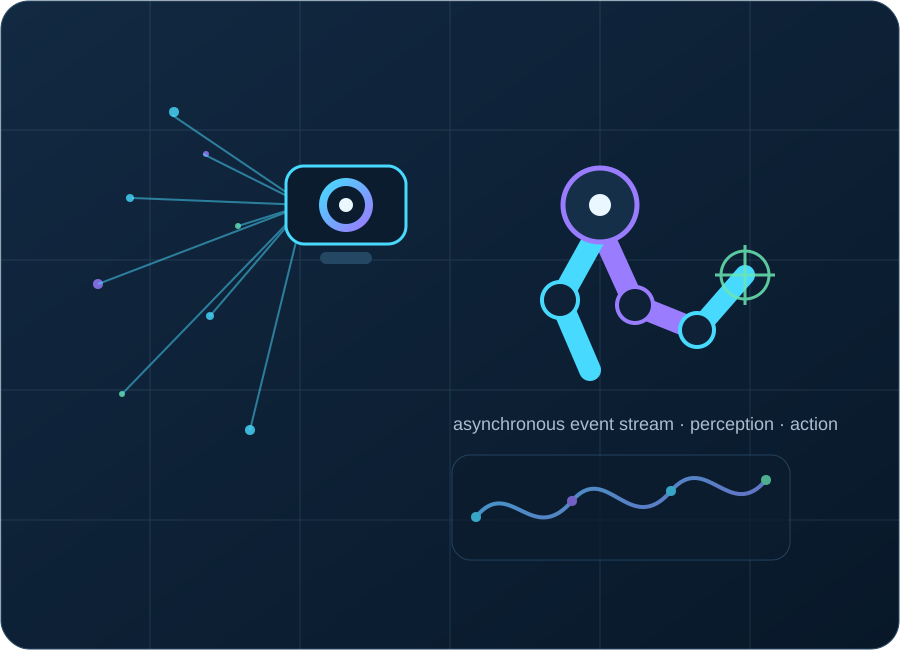
We investigate how event cameras and complementary sensing can make robots more responsive, robust, privacy-aware, and capable of understanding people during close interaction.
Frame-based vision can struggle with motion blur, changing illumination, fixed sampling rates, and unnecessary data redundancy. Event cameras report brightness changes asynchronously, creating a natural fit for rapid human motion, dynamic scenes, and low-latency robotic perception.
The real challenge is not simply collecting events. It is converting sparse event streams into reliable knowledge about human actions, falls, objects, grasp locations, intent, and safety conditions that a robot can use.
Five connected areas organize the platform and keep the projects part of one coherent research program.
Representations, recognition, detection, segmentation, tracking, and temporal learning from asynchronous visual data.
Cross-dataset, synthetic-to-real, and hierarchical transfer across sensors, environments, and tasks.
Lightweight models, quantisation, federated learning, and edge-oriented deployment.
Human state understanding for shared workspaces, healthcare, assistive systems, and collaboration.
Event-driven object recognition, grasp detection, and perception for dynamic robot interaction.
The portfolio contains nine accepted or published projects.
A systematic review of event-based human state understanding for pose, action, gesture, expression, gaze, safety, and collaborative robotics.
View project →A transfer-learning-enhanced multi-task model that jointly recognizes objects and detects grasping positions from event-camera data.
View project →Adaptive temporal resolution, motion-guided features, hierarchical transfer learning, and quantisation for resource-constrained human action recognition.
View project →Curriculum sequential federated learning for privacy-preserving action recognition under non-IID and heterogeneous event-camera data.
View project →A nine-model benchmark that trains on simulated event datasets and evaluates cross-dataset generalisation on real event-camera fall data.
View project →A coaxial RGB-event platform comparing global clock mapping and per-packet anchoring without dedicated trigger hardware.
View project →Synthetic-event training and real-event testing for human detection and instance segmentation in dynamic, occluded industrial and hospital scenes.
View project →A unified evaluation of frame-based and event-specific attacks with localization-aware purification for person detection.
View project →A taxonomy and extended analysis of event simulators, conversion techniques, sensor fidelity, and the residual sim-to-real gap.
View project →Datasets and repositories are linked where the associated paper makes them publicly available.
Resources for curriculum sequential federated learning on heterogeneous event-camera action data.
Open repository →Converted event datasets and evaluation material for cross-dataset and simulation-to-real benchmarking.
Open repository →Use this area for sensor setup videos, model demonstrations, robotic experiments, and deployment material.
Discuss a demonstration →Each publication is connected to a project page that summarizes the problem, method, evidence, datasets, and relevance to human-in-the-loop robotics.
M. H. Zafar, S. K. R. Moosavi, and F. Sanfilippo · IEEE Transactions on Human-Machine Systems, 56(1)
Accepted at the Workshop on Neuromorphic Vision: Advantages and Applications of Event Cameras · ECCV 2026
Accepted at the Workshop on Neuromorphic Vision: Advantages and Applications of Event Cameras · ECCV 2026
Accepted at the Workshop on Neuromorphic Vision: Advantages and Applications of Event Cameras · ECCV 2026
Accepted at the Workshop on Neuromorphic Vision: Advantages and Applications of Event Cameras · ECCV 2026
M. H. Zafar, S. K. R. Moosavi, and F. Sanfilippo · IEEE Transactions on Automation Science and Engineering, 22
M. H. Zafar, S. K. R. Moosavi, and F. Sanfilippo · Expert Systems With Applications, 303, 130628
M. H. Zafar, S. K. R. Moosavi, and F. Sanfilippo · Computer Vision and Image Understanding, 265, 104696
M. Z. Masood, M. H. Zafar, S. K. R. Moosavi, F. Demrozi, F. Shaukat, and F. Sanfilippo · Expert Systems With Applications, 325, 132675
Professor Filippo Sanfilippo leads the project together with Professor Nadia Saad Noori, with Muhammad Hamza Zafar and Syed Kumayl Raza Moosavi contributing as PhD Researchers.